
How to Play Pickleball: A Beginner's Guide
Some travel links on The Standard Japan are affiliate links. If you book through one, we may earn a commission at no extra cost to you.
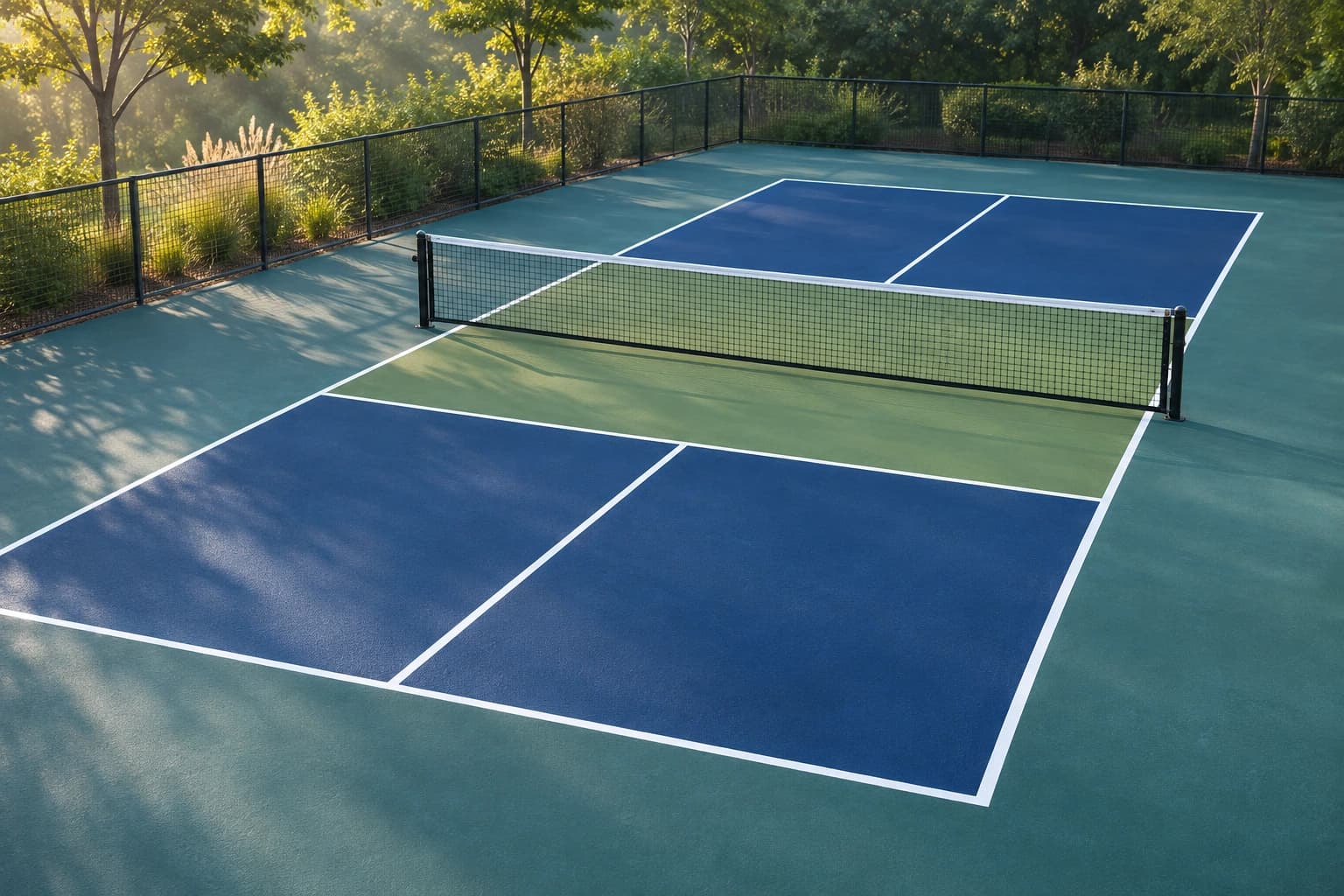
Pickleball is a paddle game on a small court. Most people play doubles, two against two. You can rally in the first session. The rules that stop a first game are the serve, the two opening bounces, the kitchen, and a score with three numbers. Learn them in that order.
The same seven lessons, with the outfit and warm-up guides beside them, are on bendiii. The measurements below are from the USA Pickleball 2026 rulebook. Ask the court which scoring method it uses before you start. Courts in Tokyo, Osaka, and Kobe, with the weekday price and the booking page, are in a separate guide.
The picture is an illustration, not a photograph of a particular court.
1. The court
The playing court is 20 feet wide and 44 feet long (6.10 by 13.41 metres). Singles and doubles use the same court. The net is 36 inches high at the sidelines and 34 inches high in the centre.
The green band is the kitchen, also called the non-volley zone. It runs 7 feet back from the net on both sides. The lines around it are part of the kitchen. The centre line splits each end into a left and a right service box.
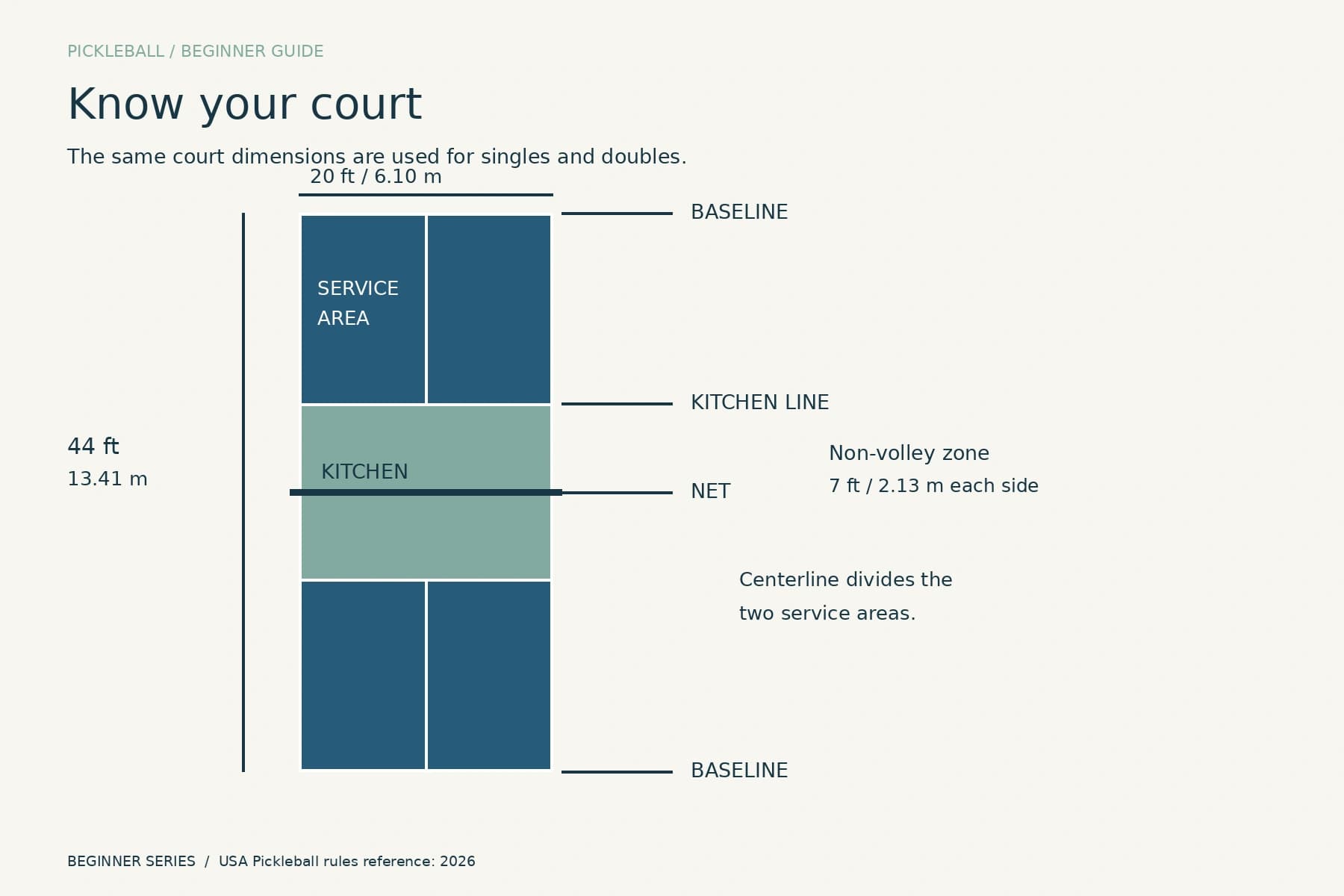
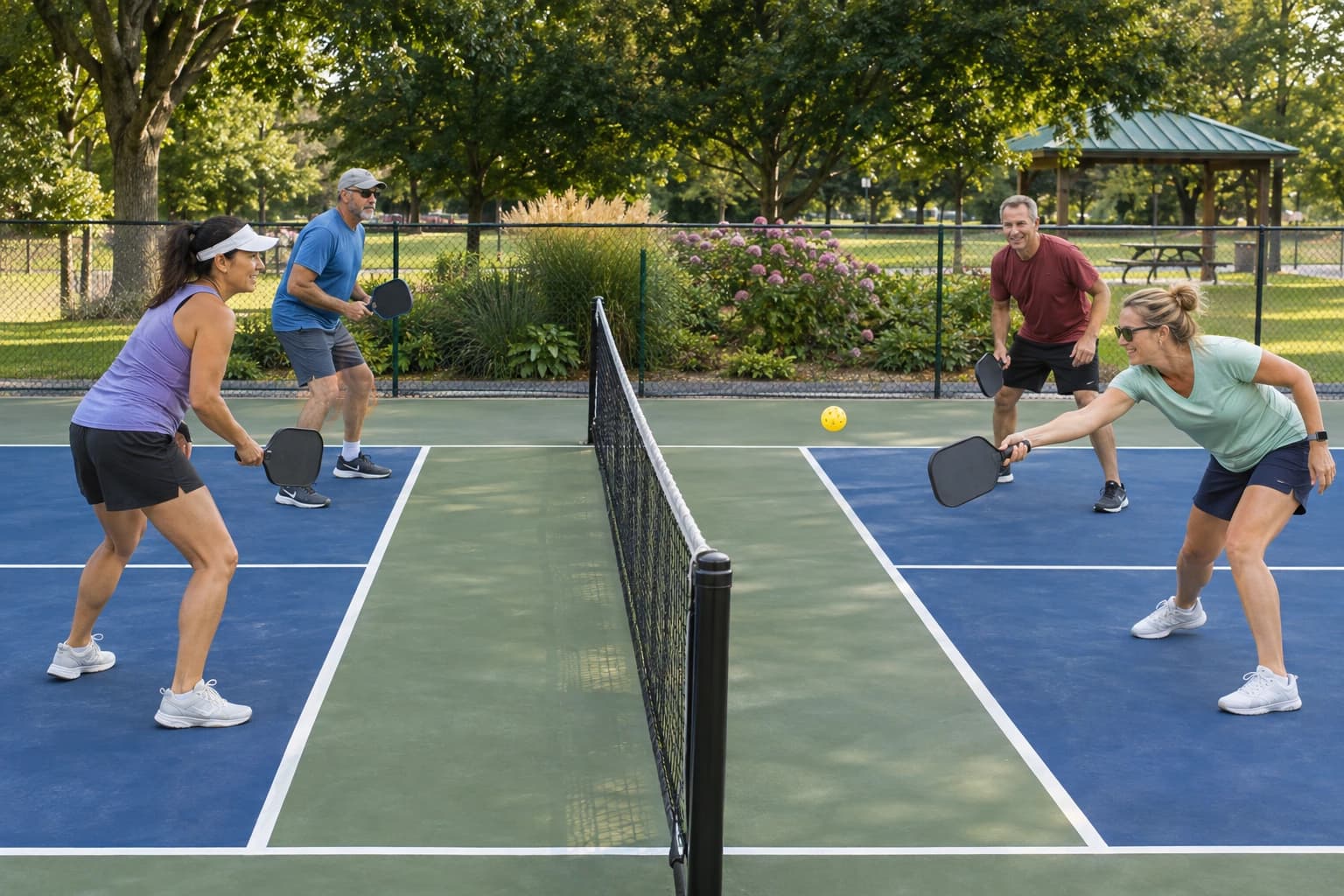
You serve from behind the baseline. After the opening bounces, most doubles teams walk up and play near the kitchen line. During the rally you can stand anywhere on your side of the net.
2. The paddle and the ball
You hit a plastic ball with holes, using a solid paddle. There are no strings. Many courts keep paddles you can borrow, so you can learn the rules before you buy one. Use the ball the court is already using. An indoor ball and an outdoor ball do not play the same.
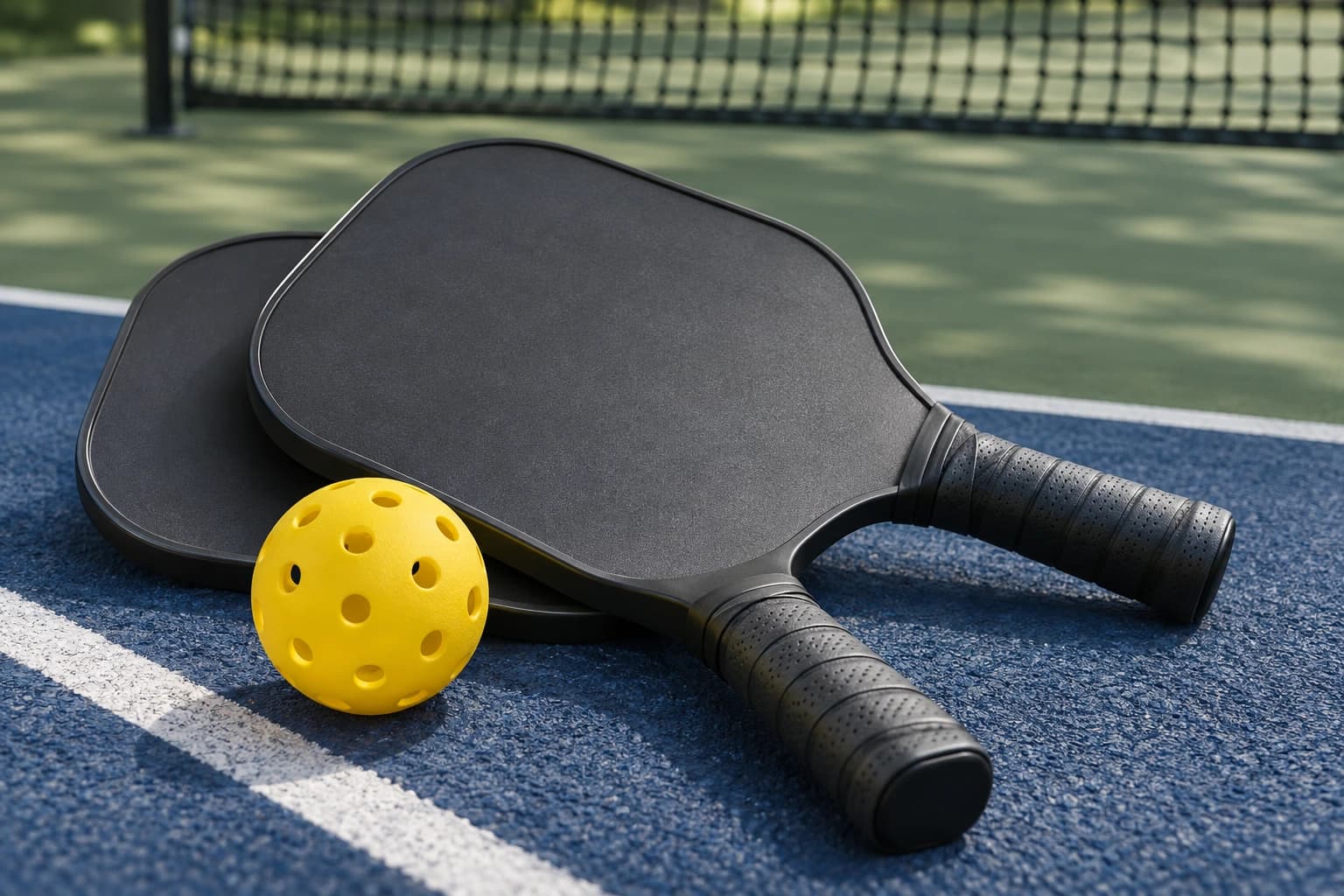
When you do buy a paddle, bendiii's thickness guide explains the 14 mm and 16 mm choice.
3. The serve
Stand behind the baseline. At the moment you hit the ball, at least one foot is on the ground in the correct serving area, and neither foot is touching the court. Aim diagonally. The ball has to clear the kitchen and land in the opposite service box. Touching the kitchen line is a fault. Touching the net is fine if the ball then lands in the right box. You get one serve. Call the whole score before you hit.
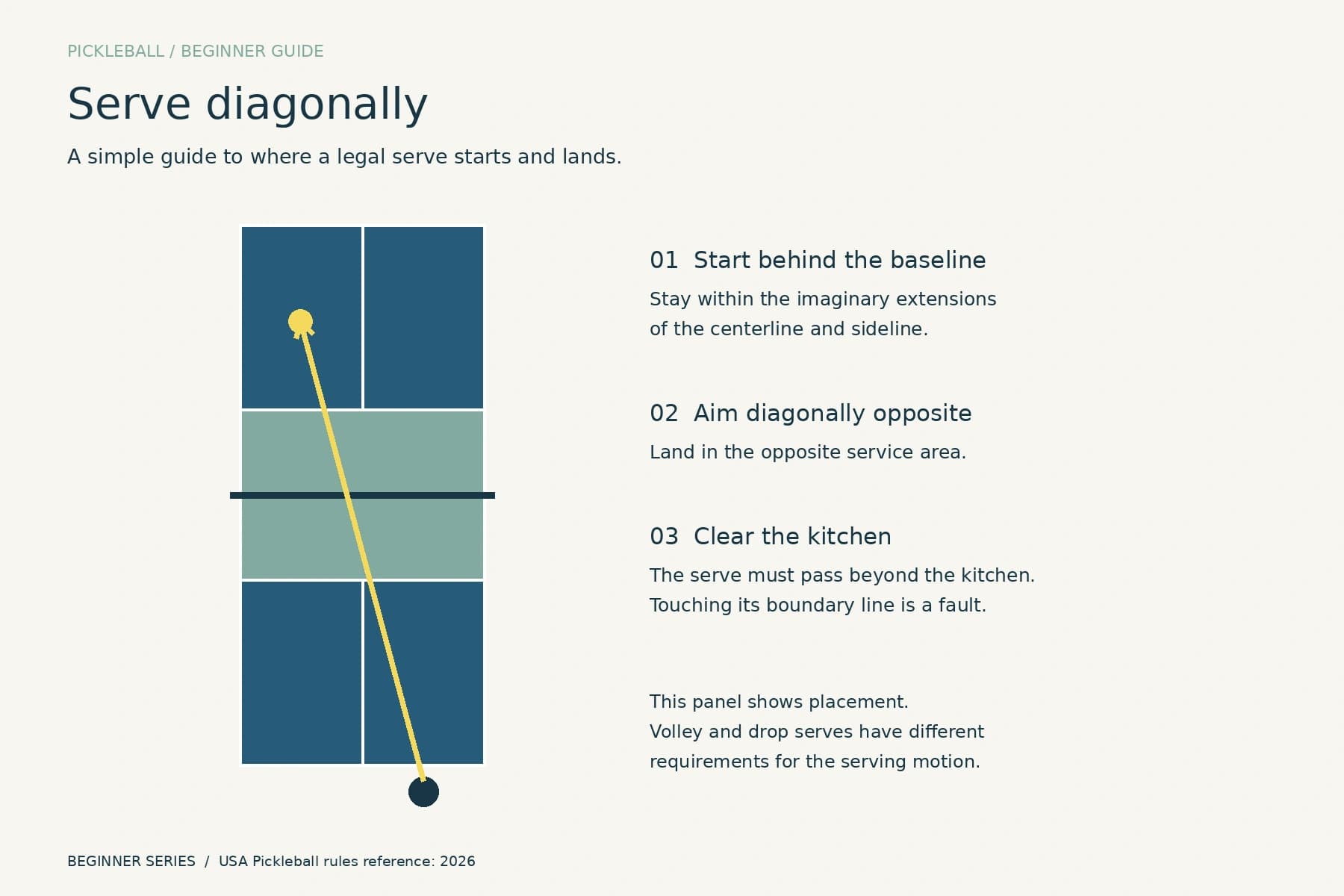
This picture shows where the serve starts and where it lands. It does not show every legal swing.
Where the ball lands is the same for both.
| Volley serve | Drop serve | |
|---|---|---|
| How it starts | You hit the ball in the air | You drop it and hit it after the bounce |
| The swing | Upward. Paddle head not above the wrist. Ball not above the waist | Those three limits do not apply |
| Best first serve | Harder to keep legal | Easier. Use this one |
Source: USA Pickleball 2026 rulebook, section 7.
If you are new, use the drop serve. Let the ball fall, wait for the bounce, then hit it diagonally. You still have to be behind the baseline, and the ball still has to clear the kitchen.
4. Let it bounce twice
Every rally starts with one bounce on each side. The receiving side lets the serve bounce, then hits it. The serving side lets that return bounce, then hits it. After that, either side may volley — hit the ball before it bounces — from outside the kitchen. Do not run to the net the instant you serve.
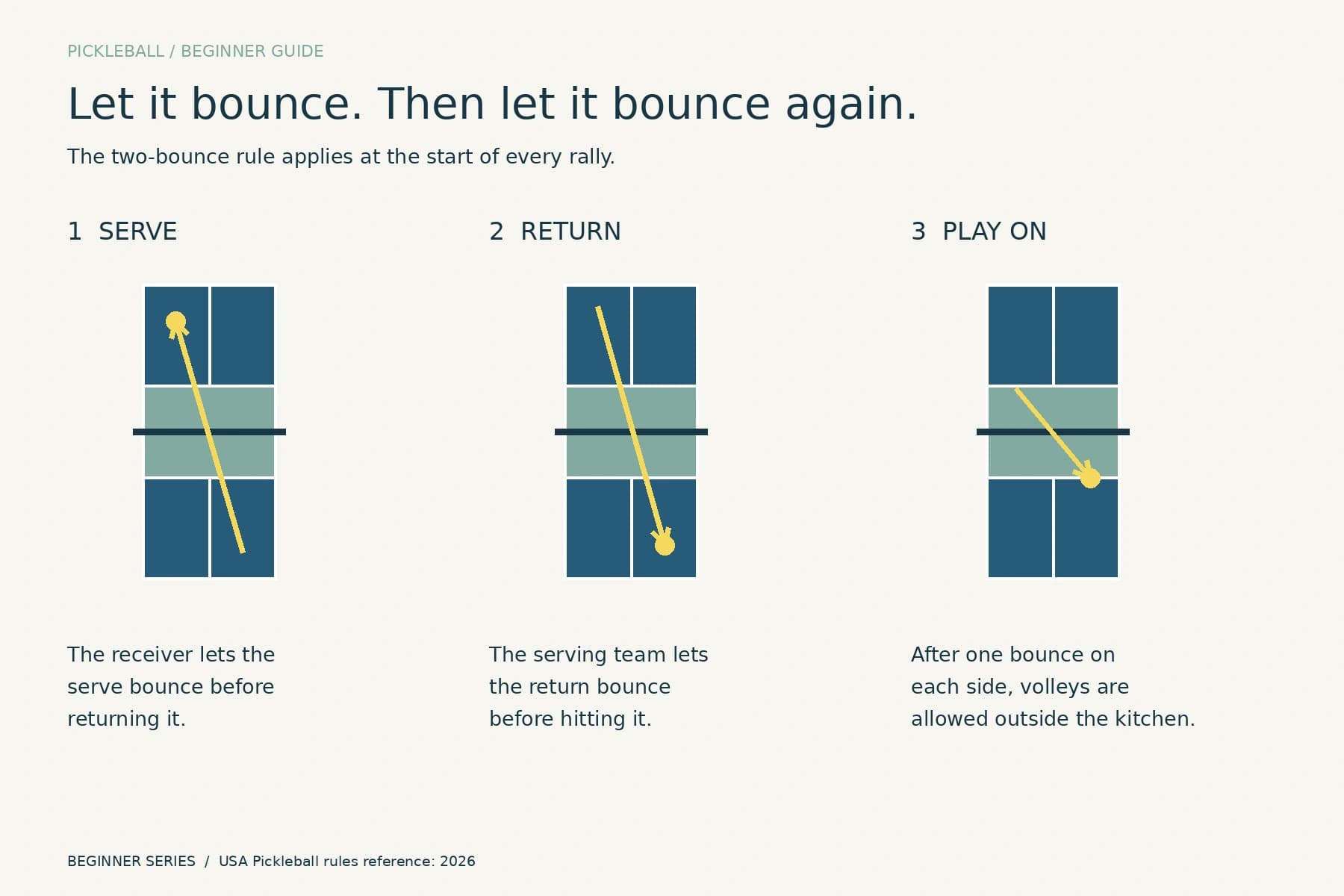
- Serve. The receiver waits for the bounce.
- Return. The serving side waits for that ball to bounce.
- Play on. Volleys are now allowed, outside the kitchen.
5. The kitchen
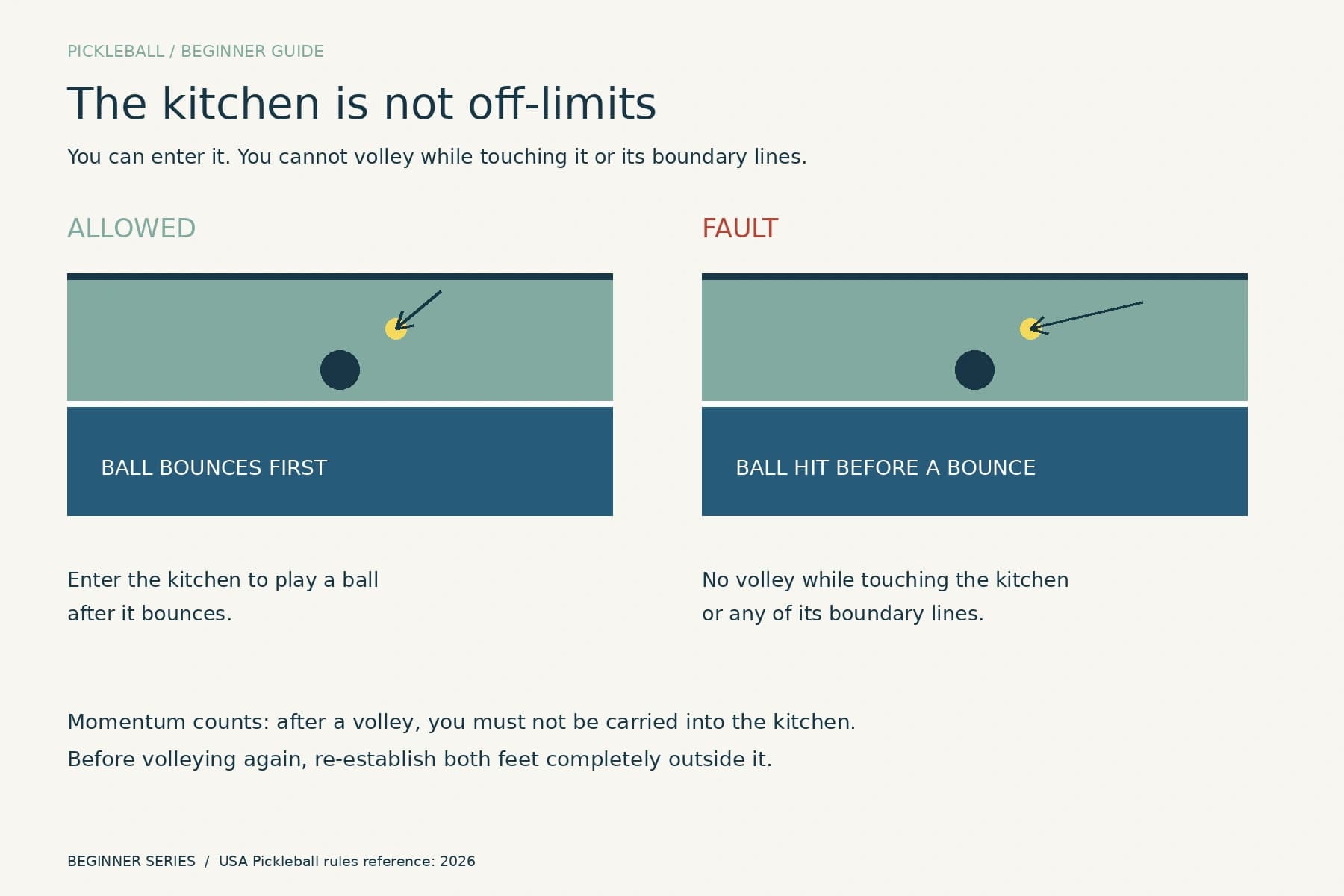
You may stand in the kitchen. You may not volley while you, your paddle, your clothes, or your partner are touching the kitchen or any line around it. If the swing carries you in, that is still a fault. To volley again, get both feet completely outside first. A ball that has bounced is different: step in and hit it.
6. On the line
Judge the spot where the ball meets the court, not the shadow. You call the lines on your own end. A ball that touches a sideline or baseline is in. A ball that misses the line is out. A serve that touches the kitchen line is short. If you cannot clearly see the ball out, call it in. If you and your partner disagree, the call is in.
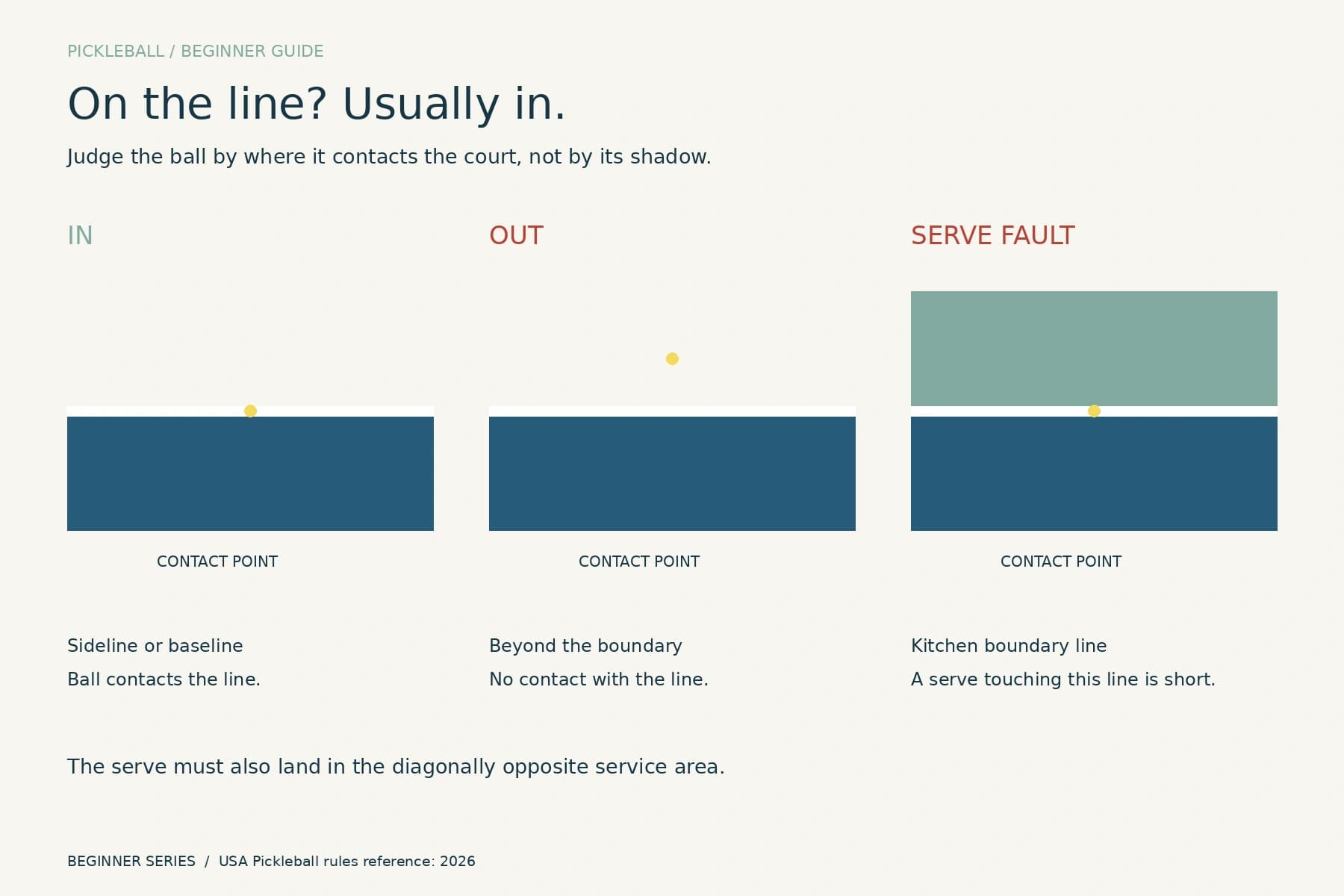
The yellow dots are contact points, not the ball. A serve also has to land in the diagonal service box.
7. The score
In the usual game, only the serving side scores. The other side has to win the rally, then serve, before it can score. Games go to 11, and you must win by 2. Some tournaments play to 15 or 21, still win by 2. Say the whole score, then serve.
- Doubles uses three numbers: your score, their score, then the server number. A new game is 0–0–2, because only one player on the first serving side serves.
- After that opening turn, both partners serve before the serve passes across the net.
- When your side scores, the server switches sides and serves again. A lost rally gives the serve to your partner, or to the other team if your partner has already served.
- Singles uses two numbers and starts at 0–0. Serve from the right when your score is even, and from the left when it is odd.
Rally scoring is a separate option. A point is scored on every rally, and the score is two numbers. If the group says it is playing rally scoring, follow that.
Your first game
- Say you are new, and ask whether the game is to 11 with side-out scoring, or rally scoring.
- If the courts are shared, put a paddle in the queue. Wear court shoes. bendiii's shoe guide explains why running shoes slide, and the outfit guide covers a pocket for the spare ball.
- Call the score. Serve from behind the baseline, diagonally, past the kitchen.
- Wait. The return has to bounce on your side before you hit it.
- Use the kitchen for a bounce, not for a smash.
- Call your own lines. On the line is in. If you are not sure, it is in.
A short warm-up is worth more than a harder serve.
FAQ
How do you play pickleball for the first time? Serve diagonally from behind the baseline, past the kitchen. Let the serve bounce, then let the return bounce. After that, volley from outside the kitchen. In the usual game only the serving side scores, to 11, win by 2.
What is the kitchen? The 7-foot zone on both sides of the net. You can go in to play a bounce. You cannot volley while touching it, and momentum into the kitchen is a fault.
What is the two-bounce rule? The receiver lets the serve bounce. The serving side lets the return bounce. Then both sides may hit the ball in the air, outside the kitchen.
Is a ball on the line in or out? A sideline or baseline touch is in. Missing the line is out. A serve that touches the kitchen line is a fault. If you cannot clearly see it out, call it in.
Why does the score start at 0-0-2? At the start of a doubles game, only one player on the first serving side gets a turn. Calling that player server 2 keeps the rest of the rotation even. After that, both players on a team serve.
Did this guide help you plan?
Responses are collected through analytics. For factual corrections, contact the editors.
Travel Desk
The Standard Japan
Trip planning: seasons and crowds, getting around, airports, where to stay, and the practical steps before and after you land.
Facts are taken from primary sources (operators, venues, official tourism and government pages) and dates and prices are checked on the day of writing. Pages are revised when those sources change.
Expertise
Seasonal crowds, transport and airports, itineraries, lodging, pre-trip logistics
Have a question or a correction?
Ask us anything about How to Play Pickleball: A Beginner's Guide, or tell us what we got wrong. We reply within 24 to 48 hours.
Related Stories
Where to Play Pickleball in Tokyo, Osaka, or Kobe
Nanko in Osaka is ¥500 on a weekday. Tokyo outdoor courts start at ¥6,000. Rain means an indoor court in Kobe or Ikebukuro.
Where to Play Pickleball in Tokyo
Rain means Ikebukuro: ¥5,500 indoors on a November weekday, ¥7,000 in December. Toyosu and Ariake are ¥6,000 outdoors.
First-Time Japan Checklist: What to Do Before You Fly (2026)
First-time Japan checklist: visas, Visit Japan Web, eSIM, Suica, cash, hotels by city, what to book ahead, and a day-one plan that won’t ruin the trip.